
Unfortunately, all new cars lose some of their value as soon as you drive them home. That’s known as ‘depreciation’.
But some cars hold their value better than others. When buying a new car, it’s worth knowing what depreciation is and how you can manage it.
What is car depreciation?
Car depreciation is the drop in your car’s value between what you paid and what you can sell or trade it for later.
Most cars take the largest hit in value in their first year. After around three years, it slows down.
It’s easy to overlook or forget when you’re looking for a new car, but it’s worth keeping in mind. Choosing a car that holds its value for longer can save you a lot of money in the long run.
Most cars lose about 15-35% of their value in the first year and half their value after three years.
So, picking a new car with a lower depreciation rate could end up saving you hundreds or even thousands of pounds.
What factors affect car depreciation?
There are a few things that can affect how well a car holds its value.
Fuel efficiency
The miles-per-gallon (MPG) of a vehicle often affects its depreciation rate. This is how many miles of distance a car can cross with each gallon of fuel in the tank.
For example, if a car’s MPG is 35, that means each gallon of fuel allows it to travel 35 miles. The higher the MPG, the more fuel-efficient the car is, and the cheaper it is overall to fuel.
Larger vehicles and engines use more fuel, which means they tend to lose value faster.
Mileage
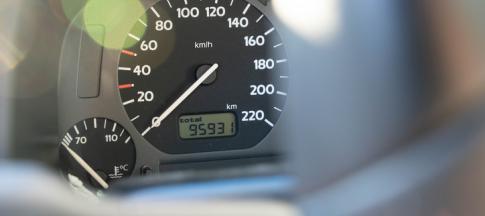
Mileage is important too. Cars keep a constant display of mileage from the first to the last use, and it’s illegal to reset or change this.
The more mileage you do in your vehicle, the less it’s worth because it’s thought of as more worn.
Some cars feel the effects of high mileage more than others and it’s these which lose their value fastest.
As a general rule of thumb, smaller cars have lower running costs and typically depreciate slowly.
The condition of your car
Looking after your vehicle and keeping it in good condition is the simplest way to avoid your car’s value dropping.
Take a look at our list of handy tips to avoid depreciation below.
Tips to reduce the effect of car depreciation
Here’s what you can do to help your car hold its value for longer:
- Buy a nearly-new or used car.
- If you’re buying a new car, pick a model with lower running costs.
- Keep the mileage as low as possible.
- Avoid adding modifications to your vehicle.
- Keep a record of all service checks and MOT certificates for when you sell or trade-in your car.
- Sell at the right time of year (convertibles and sports cars in summer, 4x4s and larger vehicles in winter).
- Stick to more common car colours (grey, white, black and silver) as they tend to be more popular.
Which cars depreciate the fastest?
We've used data from WhatCar? to show which type of cars lose their value the quickest. In the table, we’ve included their original value of the cars, then what they sell for after three years and the percentage of value kept after these three years.
| Car model | List price | 3-year resale value | Percentage of value kept |
|---|---|---|---|
| Vauxhall Corsa Electric | £29,045 | £8,300 | 28.6% |
| DS9 | £61,800 | £18,200 | 29.4% |
| Mazda MX-30 | £32,395 | £9,900 | 30.6% |
| Jeep Compass | £44,655 | £13,875 | 31.1% |
| Audi A8 | £82,485 | £56,585 | 31.4% |
| DS3 | £31,200 | £10,200 | 31.69% |
| BMW 8 Series | £117,975 | £37,975 | 32.2% |
| Lexus UX300e | £50,995 | £16,550 | 32.5% |
| Audi A6 | £60,585 | £16,550 | 32.5% |
| Peugeot e-208 | £29,950 | £9,925 | 33.1% |